We are perhaps quite familiar with, and eagerly anticipate, that early summer treat the strawberry. A simple dessert, the classic strawberry shortcake, showcases those majestic June and July berries, but late summer and early autumn – including this back-to-school period – offer delicious fruits that are prime ingredients for their own class of baked treats.
While apple pie is perhaps a definitive dessert at this time of the year – especially with that scoop of ice cream – there are lesser known dishes that warm both the tummy and the soul as cooler fall weather rolls in. They range from the pandowdy to the clafouti; from the betty to the buckle.
In mid-September, there are still stonefruits like peaches, plums and the odd apricot around as well as lots of pears and apples; perhaps so much so that you may not be able to eat them one piece at a time before they start to get too ripe.
A good strategy is to purchase and cook them in bulk. And it’s all the better when you start using heady autumnal spices like cinnamon, cloves, allspice and nutmeg.
There is a wide range of these dishes; some will be familiar and some not. What is clear is that their names are closely associated with and perhaps even mimic their physical characteristics: crisps, crumbles, cobblers, buckles, slumps and grunts. (I have no comment about bettys.)
The crisp, for instance, is a basic baked fruit dish (apples and pears combine nicely) that is topped with a fine streusel layer of butter, sugar and flour that becomes crisp when cooked.
Juxtapose that with a crumble, which often has oats in a topping that is moister and will – you got it – « crumble » under its own weight when served.
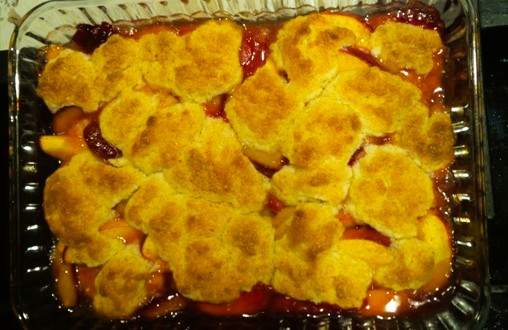
When you move into cobbler territory, you are in the heartland of baked fruit desserts: it’s a very deep dish fruit pie (without a bottom crust) made with a quick bread or biscuit-like topping.
Many desserts are variations on the cobbler, which uses fairly large chunks of fruit; early recipes might even call for whole peaches, including the pit.
Of English and colonial American origin, the cobbler may take its name in light of ingredients missing for a traditional suet pudding: shards of biscuit or thick cracker were instead broken up and arranged – cobbled together, in other words – to form a topping that might also be said to look like a cobblestone road.
Though a much difference consistency than a cobbler, the clafouti, which hails from Limousin, France, also uses large chunks of fruit, traditionally whole cherries, submerged in its thick batter. Peaches, plums and pears are also used.
A concoction that has a name that implies a somewhat unfashionable appearance is the pandowdy. Similar to the cobbler, the pandowdy carries with it a sense of something frumpy. The dish may look a bit dowdy due to a technique which sees its topping, a rolled-out dough, smashed down into the filling part way through the cooking time. The result is still tasty, however.
The venerable Joy of Cooking: The All-Purpose Cookbook, published in 1931, lists four fruity dessert comestibles called “betties:” brown, prune, apricot and pineapple. These are usually multi-layered and baked desserts often with a dried bread or Graham-cracker crumb base. They should have a bread pudding quality according to the book’s authors, though they have no answer for the origin of the name.
That leaves slumps and the onomatopoeic grunts: the former were said to collapse when served (imagine earth slumping down a slope); the latter were thought to make « grunting » sounds while they baked. You will find recipes for blueberry slumps from Canada’s east coast: they usually have more fruit filling than biscuit-style topping.
Finally, like the slump and the grunt, the buckle is a fruit and cake batter dessert with a streusel topping which “buckles” or shifts as it is served.
Given these various fragilities and structural collapses, it would seem a good thing that early bakers and pastry chefs stayed in the kitchen and avoided a career in civil engineering.
Food writer Andrew Coppolino lives in Rockland. He is the author of “Farm to Table” and co-author of “Cooking with Shakespeare.” Follow him on Instagram @andrewcoppolino.